A transaction fee is not a perpetual hosting contract.
Hashes do not recreate missing inputs. A useful system still needs retention, discovery, schemas, interfaces, and people who care enough to keep it running.
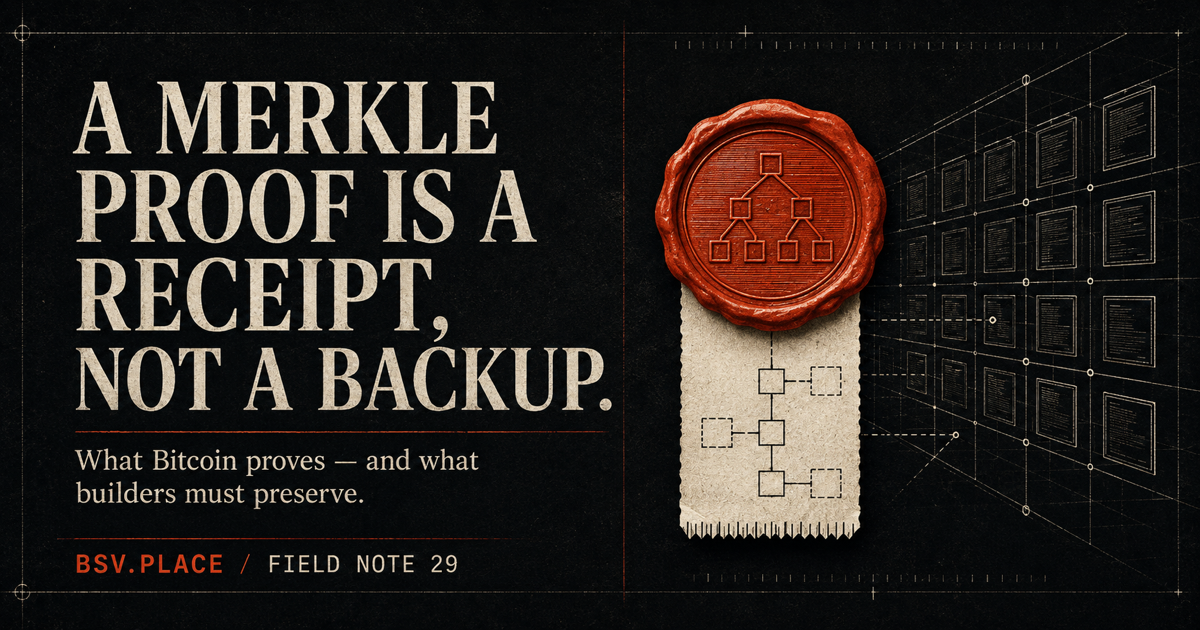
If nobody keeps the transaction bytes, no hash can bring them back. That concession does not make Bitcoin a hard drive. It reveals Bitcoin's narrower job: giving separate parties an independently checkable commitment to retained records. Current accepted history and spend status require additional evidence.
The strongest version says this: if miners may prune old block data, and an application still needs hosts and indexes to retrieve it, then putting data through Bitcoin added no value. The overlay was the real product all along.
Hashes do not recreate missing inputs. A useful system still needs retention, discovery, schemas, interfaces, and people who care enough to keep it running.
A retained record plus a proof can be checked against shared history without trusting the app, the indexer, or the peer that supplied the record.
This field note grew from a public exchange about Twetch, Treechat, pruning, and what a blockchain contributes when it is not treated as free cloud storage. Read the closing post on X ↗
Calling all of this “on-chain data” hides the useful boundaries. Keep the objects separate and the architecture becomes testable.
The actual inputs, outputs, scripts, and payload. Hash them to derive the transaction ID.
Lose these and the hash cannot reverse itself.A compact fingerprint of the serialized transaction. Any changed byte produces a different ID.
Identifies data; does not contain it.The neighboring hashes and positions needed to recompute the block's Merkle root from the transaction ID.
Proves inclusion relative to a root.The Merkle root, previous header hash, difficulty, nonce, and block timestamp linked into proof-of-work history.
Links the commitment to a history; check current acceptance separately.You can recompute its ID, follow the Merkle path to the root, check that root against a header, and evaluate the relevant transaction ancestry and scripts. That is the SPV evidence path described in the whitepaper and BRC-67.13
You have a commitment with no preimage. The proof cannot recover the post, photo, invoice, sighting, or payment record that produced the transaction ID. Prune mode makes this distinction operational, not philosophical.4
A credible decentralization claim names which layer can be replaced, who retains its state, and what a newcomer can verify.
Interface, moderation, ranking, support, culture, attention, and the reasons people return.
If the company disappears, what human value survives—and where do people reconvene?
Keys, accounts, certificates, permissions, encrypted material, and private mappings.
Can a user export, decrypt, understand, and restore this without the original provider?
The rules that make a signed record mean “post,” “reply,” “follow,” “like,” “sighting,” or “payment.”
Is the schema versioned, public, implementable, and sufficient to interpret old records?
Retention, topic admission, indexes, queries, synchronization, service discovery, and delivery.
Can another host obtain the records, rebuild the index, and answer the same useful query?
Transaction rules, spend resolution, Merkle commitments, proof-of-work ordering, and settlement.
Can a new participant validate what it receives without trusting the original app or indexer?
Overlay specifications deliberately cover the fourth job: hosts admit relevant transactions, propagate them, synchronize state, and serve application-specific lookups. That is infrastructure, not an embarrassment. Its independence still has to be demonstrated through multiple reachable hosts, export, and recovery tests.56
Each example proves something bounded. None earns a blank cheque.
Treechat currently states that it surfaces records from earlier BSV social networks, including Twetch. That is evidence that some public records and shared meaning could outlive one frontend.
The thread began with a concrete concern: if the bird-sighting site disappears, can someone recover and understand the sighting? The transaction is inspectable; the durable answer also needs its schema, any referenced media, and a reconstruction path.
OpenTimestamps keeps the architecture honest: a document stays with its holder; a compact proof anchors its digest to Bitcoin. Verification requires both. The chain is a timestamping trust anchor, not a document host.
The IETF's Certificate Transparency design uses Merkle inclusion and consistency proofs so certificate issuance can be audited. It still requires logs and monitors to retain and serve entries.
“No centralized database does this better” is too broad. The useful comparison is about authority and verification, not database performance.
The differentiator is not “stores bytes.” It is a proof that can cross organizational boundaries. If no user or counterparty needs that property, do not add a blockchain.
A durable application should not ask its future users to reverse-engineer a dead service.
Give the user the raw transaction or payload needed to recompute the identifier—not only a transaction ID.
Include the Merkle path and the header or header source needed to evaluate it, plus a stated confirmation and reorganization policy.
Version the protocol, schema, encodings, field semantics, and migrations. A future implementer should know what the bytes say.
Document topic admission, index construction, queries, host discovery, and synchronization. One hidden index is still a silo.
Name what is not public: keys, certificates, identity mappings, encrypted objects, permissions, moderation state, and referenced media.
State who retains which bytes, for how long, under what incentives, in how many failure domains, and how users can keep their own copy.
Rebuild the useful view from the bundle without the original frontend, database, domain, or operator.
Record what survived, what did not, and which claims must be narrowed before anyone says “user-owned” or “permanent.”
“The blockchain stores your application forever.”
“The block header durably commits to this transaction. Availability depends on who retains and serves the transaction data.”
“The frontend is just a window. There are no silos.”
“A replaceable frontend is possible only where records, meaning, identity state, and indexes are open enough to reconstruct.”
“No centralized database can do this better.”
“A centralized database is simpler unless multiple parties need independently verifiable settlement or shared ordering without one final administrator.”
No. It contains the neighboring hashes and position information needed to recompute a Merkle root from a transaction ID. You still need the transaction bytes—or at least the exact item whose hash you are proving—to establish what was committed.
The accepted block header commits to the transaction's ID, but retrieval is an availability question. A transaction processor, archive, application host, wallet, publisher, or user must retain the transaction bytes. A pruned node may retain the header chain while discarding old block bodies.
It supports a time-bound claim that the transaction existed by its inclusion in a block. It is not a precise notarized wall-clock time: BSV's protocol documentation says current policy allows a block timestamp within two hours of validating nodes' local time.
Not necessarily. The overlay answers discovery and application-specific meaning; Bitcoin evidence can support inclusion, transaction validity and ordering under a chosen history. Current spend state requires current spend/conflict evidence; a retained inclusion proof is insufficient. But if one overlay is the only place that retains essential bytes or private mappings, availability remains centralized.
It may reconstruct records and interactions whose schemas and bytes survived. It cannot automatically recreate private account data, decryption keys, moderation state, ranking choices, company operations, attention, or community. Recovering records is not the same as recovering a product.
Use it when multiple parties need independently verifiable settlement or a shared sequence of events and should not have to accept one database administrator as the final authority. For private, editable, high-query, single-operator data, an ordinary database is usually the better default.
The public exchange supplied the question. Specifications, implementation records, and live systems bound the answer.
Sections 3 and 8 describe the distributed timestamp server and the Merkle branch linking a retained transaction to a block in the proof-of-work chain.
Satoshi Nakamoto · accessedDefines the block header, Merkle root, proof construction, and the important limitation that the block timestamp is not a precise civil-time attestation.
BSV Association · accessedLists the transaction, ancestry, script, fee, locktime, sequence, and Merkle-path checks needed for application-side verification.
BRC contributors · accessedDocuments the node's prune mode and the resulting failure to retrieve block data that is no longer present on that node.
Bitcoin SV node maintainers · accessedSpecifies host discovery, relevant-transaction propagation, lookup availability, and synchronization across interested overlay services.
BRC contributors · accessedMakes query and hydration a distinct service layer rather than pretending a block commitment is itself an application index.
BRC contributors · accessedTreechat states that it preserves and surfaces records from earlier BSV social networks. This is operator evidence of a live recovery surface, not an independent completeness audit.
Treechat · accessedThe transaction raised the practical recovery question in the original thread: what must be retained and documented so a sighting survives the application?
BananaBlocks · accessedAsks whether Twetch posts and a BananaBlocks bird sighting can still be found and understood after their original applications disappear.
Old Craig on X · accessedPresses the strongest application-layer concern: product context, authentication, private state, and social meaning do not become portable merely because transactions exist.
Jataka on X · accessedFrames the miner-returned Merkle proof as a receipt for ordering and timestamping. The field note preserves that useful claim while narrowing its database comparison.
Project Babbage on X · accessedArgues that pruning, off-chain retention, and application indexes collapse the value proposition. The field note concedes the availability premise and tests the conclusion.
Robert Greene on X · accessedSeparates community, interface, identity, protocol meaning, indexes, record availability, and Bitcoin verification instead of calling every layer decentralized.
Project Babbage on X · accessedA production example of retaining a document separately while anchoring a compact, independently verifiable Bitcoin timestamp proof.
OpenTimestamps contributors · accessedShows the same separation outside blockchain: Merkle proofs support auditability, while logs and monitors must still retain and serve the underlying entries.
Internet Engineering Task Force · accessedChoose a live BSV application. Export one user's complete evidence bundle. Turn off the original frontend and index. Rebuild the useful state with an independent implementation. Publish the code, time, cost, gaps, and failures. That would move this conversation from architecture claim to public proof.