One reading, three parties
Imagine a refrigerated shipment producing an overheating record. The customer wants to know whether the goods were kept within bounds, the supplier wants to understand a disputed delivery, and an auditor wants an inspectable account. They may need a shared reference even after the application that first displayed the event is gone.
The strongest ledger case is specific: a compact commitment can let parties compare retained records against a common reference and inspect their inclusion and ordering under an explicit acceptance policy. That can reduce reliance on one party’s editable database as the only account. It does not eliminate reliance on devices, keys, retention providers or settlement rules.
Start by naming the fact to verify. ‘These bytes match the earlier commitment’ is different from ‘this device signed them,’ ‘the temperature was accurate,’ or ‘the supplier is liable.’ A design that answers the first question has not automatically answered the others.
Basis: The IoT usefulness questionBitcoin whitepaper · sections 5, 6 and 8
Keep the evidence layers separate
A signature can support attribution to a key and integrity of the signed message under its cryptographic assumptions. It does not establish sensor calibration, secure installation, correct location or an honest measurement. A signed false reading remains false; device provenance and independent observations need their own evidence.
A retained record can be compared with a commitment. A Merkle proof can link it to a particular block. The block’s place in currently accepted history and the practical finality of settlement require additional checks. None of those operations reconstruct missing bytes, a missing schema or an unavailable decryption key.
The useful architecture assigns each job an owner and a test. Preserve the record and schema, explain the device’s trust assumptions, and state what a third party can check without the original frontend. If a legal or operational decision relies on more than the ledger establishes, name that additional evidence.
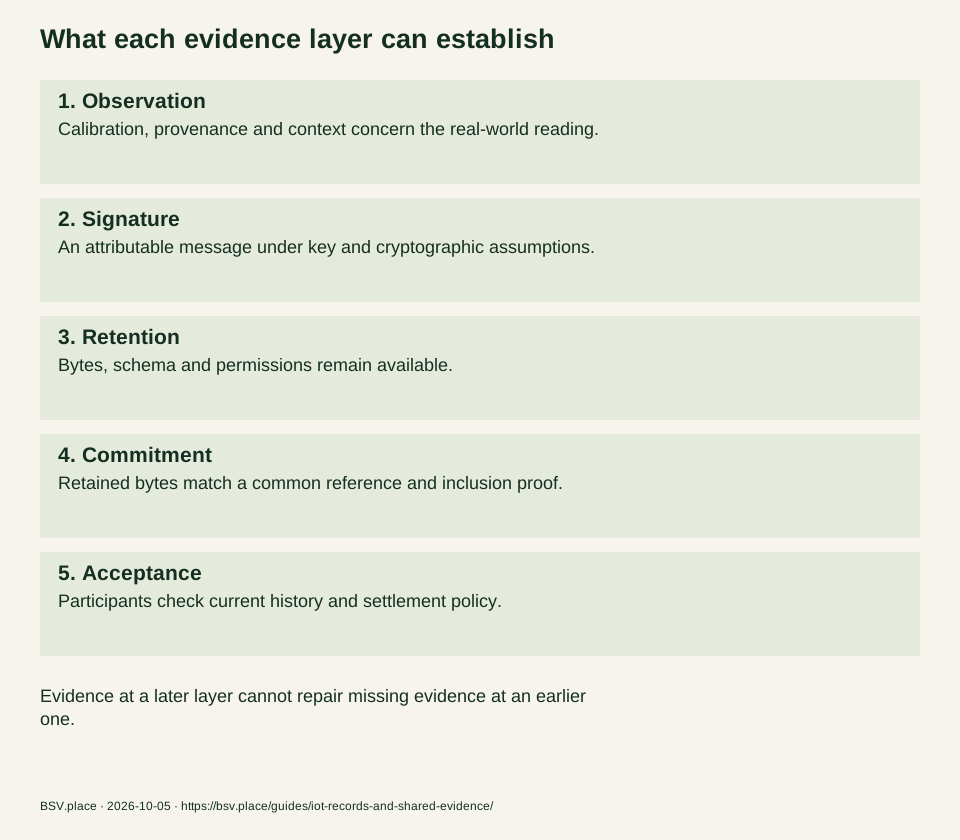
- ObservationCalibration, provenance and context concern the real-world reading.
- SignatureAn attributable message under key and cryptographic assumptions.
- RetentionBytes, schema and permissions remain available.
- CommitmentRetained bytes match a common reference and inclusion proof.
- AcceptanceParticipants check current history and settlement policy.
Evidence at a later layer cannot repair missing evidence at an earlier one.
Basis: NIST FIPS 186-5 · Digital Signature StandardBitcoin whitepaper · sections 5, 6 and 8
Compare three ways to do the same job
A signed database log can be enough when one accountable operator is acceptable and parties can retain copies. A transparency design can help expose inconsistent histories when appropriate monitoring and consistency checks exist. A public ledger anchor may help when independent parties need a common accepted reference and can justify its additional operating model.
These are design families, not interchangeable products. RFC 9162 supplies a concrete transparency example from certificate infrastructure; it is not an off-the-shelf IoT solution. Compare implemented designs for the actual task, including outages, retention, operator misconduct, correction handling and full cost.
| Design | Useful property | Remaining dependency | Good reason to choose it |
|---|---|---|---|
| Signed database log | Attributable records and an efficient query surface | Key security, retained copies and an accountable operator | One operator is acceptable; editing and private queries matter |
| Transparency service | Inspectable inclusion and consistency under its design | Log availability, monitors and response to inconsistent views | Public auditability is needed without general transaction settlement |
| Ledger anchor plus retained records | Common commitment and accepted ordering under network policy | Record availability, fees, services, governance and settlement | Independent parties benefit enough from a shared public reference |
Basis: RFC 9162 · Certificate Transparency v2Bitcoin whitepaper · sections 5, 6 and 8
Anchor the minimum useful material
Cheap blockspace is not a reason to publish every raw reading. An application may batch commitments while retaining detailed data under appropriate access controls. Decide what must be public and what recipients must preserve. A hash can still reveal information through guessing or correlation when its input is predictable; a compact commitment is not automatically a privacy solution.
Budget for the whole workflow: device operations, retained copies, queries, proof retrieval, wallet and service support, transaction costs and recovery. A throughput promotion answers neither whether anyone needs the service nor whether it is cheaper per successful user task. Useful demand, measured capacity and operator economics require separate evidence.
Corrections need a policy too. If a device was miscalibrated, preserve the original record and a linked correction with the reason and authority. Do not describe immutable evidence as permanently correct interpretation. Readers need enough context to understand why the assessment changed.
Basis: The IoT usefulness question
Choose by the verification job
Use the worksheet to name the parties, disputed fact, acceptable operator trust, retention plan and irreversible consequence. Compare all candidates against the same requirements. Choosing a database after that comparison is a successful outcome when it best serves the user.
The sample manifest is deliberately synthetic and contains no transaction ID, proof or claim of deployment. It shows which categories of material a recovery package might need: record files, schema, device/key context, commitment, proof, acceptance reference and access instructions. A real implementation should specify exact formats and produce a successful independent restore before calling that package tested.
If the original application disappears, another reader should still know what the record means, where the authorized bytes are kept and what can be verified. This is where public proof and practical preservation work together. Link an actual test result when available, including failures and the scope of what was recovered.
- Name the exact shared fact and why independent verification matters.
- Choose acceptable trust in devices, operators and settlement providers.
- Compare retention, privacy, cost and failure recovery for each candidate.
- Build the smallest bounded demonstration and record actual results.
- Retain the evidence and revise the choice when the comparison changes.
What would change this assessment?
A measured workflow can show that common commitments improve dispute handling or recovery enough to justify their cost. If ordinary signed records meet the need more simply, use them. Neither throughput nor a signature establishes real-world truth.
Keep and reuse the work
These assets carry their scope, date and source page. Templates are proposed tools; blank or synthetic records do not establish tested results.
- Evidence diagram as SVGAccessible text, scope and canonical source retained.
- Full article as MarkdownReadable offline, including source notes and limits.
- IoT design comparison worksheetCompare the same job across three designs.
- Synthetic export manifestIllustrative only; no chain transaction or tested recovery.
Structured public library · Use the canonical page and preserve qualifications when quoting or adapting an answer.
Sources and provenance
The reasoning above stands on this page. The original exchanges record how the question developed; publication on X is not independent proof that a claim is true.
- The IoT usefulness questionreported · Access recorded 2026-10-05
October 4 question about why IoT records need a blockchain. It motivates a design comparison, not a demand forecast.
- Bitcoin whitepaper · sections 5, 6 and 8documented · Access recorded 2026-10-05
The original network, incentive and verification model. It does not document later BSV institutions.
- NIST FIPS 186-5 · Digital Signature Standarddocumented · Access recorded 2026-10-05
Signature verification addresses authenticity and integrity under key assumptions. It cannot establish that a sensor measured the world correctly.
- RFC 9162 · Certificate Transparency v2documented · Access recorded 2026-09-05
A concrete non-blockchain transparency design; not a drop-in IoT system. Inclusion, consistency, retention and monitoring are distinct responsibilities.