Three responsibilities that make stewardship useful
Maintaining a shared system is work. Someone must preserve the rules, implement them, explain their application and repair mistakes. Denying that work exists does not remove power; it can make the people doing it less visible. The constructive question is how responsibilities can be bounded, checked and continued by others.
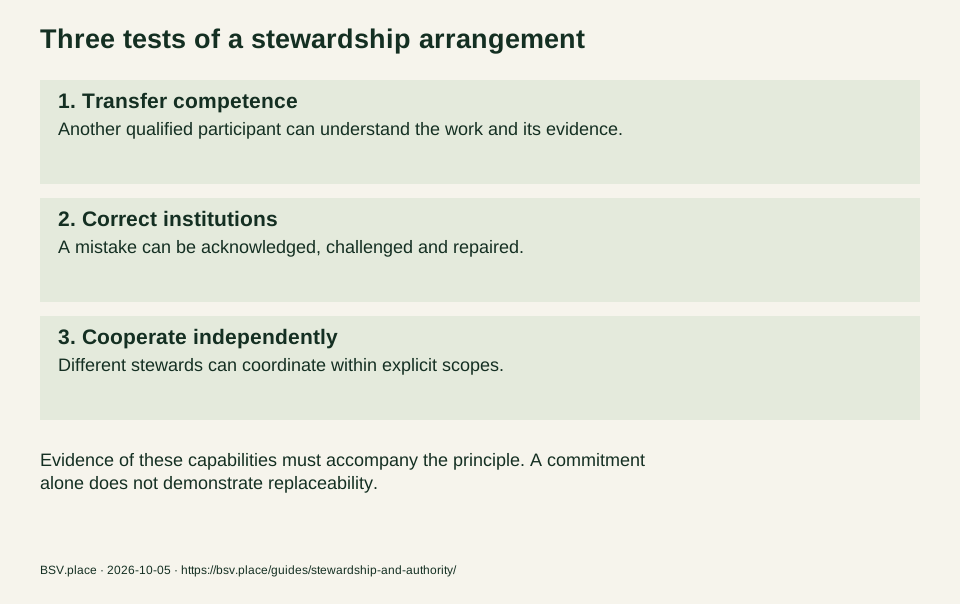
BRC-187, an opinion authored by Ty Everett, supplies a framework for this discussion. We interpret its practical demands as transferable competence, correction within institutions, and cooperation among independent stewards. Because this site is maintained by Project Babbage, the related authorship is material. The essay explains a position; it is not outside verification that BSV already meets it.
- Transfer competenceAnother qualified participant can understand the work and its evidence.
- Correct institutionsA mistake can be acknowledged, challenged and repaired.
- Cooperate independentlyDifferent stewards can coordinate within explicit scopes.
Evidence of these capabilities must accompany the principle. A commitment alone does not demonstrate replaceability.
Can another competent person continue the work?
For a software maintainer, this means more than publishing a repository. A successor needs build instructions, tests, release provenance, supported behavior and an intelligible account of design choices. A public interface helps separate applications from a particular implementation, but compatibility and licensing still determine whether a substitute is practical.
For a service, continuity also requires usable data. A replacement overlay cannot reconstruct absent records from a name or endpoint. The records, schema, indexing rules and authorization model must be available to the party that needs them. A documented export becomes much stronger evidence after a restore in an independent environment.
Transferable competence is therefore a useful affirmative goal: preserve enough knowledge for another responsible person to act. It does not imply that all production infrastructure must be public, that every operator shares private data, or that a formally assigned institutional authority can be replaced simply by copying its software.
Basis: BRC-187 · stewardship opinionBRC-100 · wallet to application interface
Can an institution correct itself?
A correction path needs an accountable owner, a way to supply evidence, a record of the decision and a means to revisit it. It should work when the challenger is unfamiliar or critical. A formal complaint channel with no observable handling history provides less assurance than a process whose corrections can actually be inspected.
Scope matters. A maintainer can correct code or documentation without determining a legal dispute. A business can change a payment policy without rewriting a standard for everyone. A coordinator can communicate evidence without making the communication itself proof of the evidence. An explanation should name the act and the authority for it rather than group everything under ‘governance.’
Apply this standard to our own work. A mistake in a supportive argument deserves the same correction as a mistake in a criticism. The October mining guide consequently preserves the acceptance mechanism while retiring the inference that rejection must always succeed. Correctability makes a position more reliable because readers can see what survives scrutiny.
Basis: BRC-187 · stewardship opinionProject Babbage’s answer on mining and economic acceptance
Identify the system apart from its custodian
The strongest part of the stewardship argument is that a rule can be stated independently of the person applying it. Two competent stewards using the same complete rules and relevant evidence should obtain the same validation result. Where the selection conditions uniquely determine a history, they should also identify the same resulting state. The premises must be exposed: different evidence, incomplete rules or unresolved selection conditions can prevent that conclusion.
This makes replacement without redesign conceivable. A new maintainer can preserve an interface; another service can apply an existing application rule. Responsibility for maintaining a system does not, by itself, justify changing its underlying undertaking. BSV’s stated preference for a stable core is a stewardship commitment to examine against actual rules and conduct, not a license to skip that examination.
For example, two warehouse-receipt services could recognize the same issuers, use the same admission rules and inspect the same available evidence. They could produce compatible results without one owning all interpretation. They still need sufficient records, consistent implementations and an explicit way to handle missing or conflicting evidence. A public query interface alone would not prove those conditions.
If the complete rule set includes an external directive, both stewards must identify that input. Reproducing its technical consequences is different from independently justifying the directive. Plural stewardship is strongest when this dependency is visible, rather than concealed inside the word ‘objective.’
Basis: BRC-187 · stewardship opinionNetwork Access Rules · Part III
A disagreement between two operators
Consider two operators reaching different conclusions about the same event. First they compare the actual inputs: transaction or record, rule version, implementation version and any external instruction. If their inputs differ, the useful work is to identify the difference. If the same input produces different technical results, a reproducible implementation discrepancy may explain it.
If they agree on the technical effect but disagree about an instruction’s legitimacy, rerunning the same code will not resolve that disagreement. They need the applicable authority and challenge process, and an account of what services do while the disagreement persists. A signed message establishes an attributed instruction, subject to key assumptions; it does not resolve the merits by itself.
Independent stewards cooperate by making these boundaries legible. Agreement can be an outcome of shared rules and evidence, but agreement with our preferred conclusion cannot be the definition of honesty. An unresolved disagreement must remain visible. The miner, wallet, business and user may also face different immediate consequences.
- Compare inputs and rule versions.
- Compare the technical result.
- Separate implementation differences from disputes over authority or judgment.
- Use the relevant challenge process and record interim service policy.
- Publish the reasoned outcome, remaining dissent and resulting correction where appropriate.
Basis: BRC-187 · stewardship opinionNetwork Access Rules · Part IIISV Node alert system
Make a responsibility statement portable
Every critical dependency should have a short responsibility statement: what it controls, why, who can change it, what evidence it exposes and what continuity requires. The downloadable template also asks who handles a challenge and what has actually been tested. These questions are useful for an independent builder as well as a large institution.
Do not infer independence from separate names alone. Shared hosting, funding, administrators, licenses or signing keys may constrain real choices. Equally, institutional concentration is not proof that every independent builder is controlled by one sponsor. Record supported relationships and unknowns rather than making either sweeping assertion.
The strongest argument for plural stewardship is a demonstrated ability to preserve competence, correct errors and cooperate across independent scopes. It improves as replacement and challenge paths become practical. It weakens when undocumented discretion expands, important records disappear or a supposed alternative cannot perform the promised job.
What would change this assessment?
Independent continuation, reproducible decisions and meaningful correction histories strengthen the framework’s practical case. Opaque discretion, unavailable evidence or unusable replacement paths weaken it. The framework never substitutes for the actual authority record.
Keep and reuse the work
These assets carry their scope, date and source page. Templates are proposed tools; blank or synthetic records do not establish tested results.
- Evidence diagram as SVGAccessible text, scope and canonical source retained.
- Full article as MarkdownReadable offline, including source notes and limits.
- Authority and dependency matrixThe HTML matrix as CSV, with sources and evidence states.
- Responsibility statement templateFor a maintainer, service, business or institution.
Structured public library · Use the canonical page and preserve qualifications when quoting or adapting an answer.
Sources and provenance
The reasoning above stands on this page. The original exchanges record how the question developed; publication on X is not independent proof that a claim is true.
- BRC-187 · stewardship opinioninterpretation · Access recorded 2026-10-05
Ty Everett’s authored stewardship framework. BSV.place is maintained by Project Babbage; this is a related author’s position, not independent corroboration or a deployed governance specification.
- Network Access Rules · Part IIIdocumented · Access recorded 2026-10-05
Published Association directive powers and event categories. Read the operative text for scope and conditions.
- SV Node alert systemdocumented · Access recorded 2026-10-05
Documents signed information and directive messages. Message authentication is not a judgment on the merits, and documentation is not a deployment audit.
- SV Node Safe Modedocumented · Access recorded 2026-10-05
Documents protective detection and operator intervention for SV Node. Not a deployment or convergence test.
- BRC-100 · wallet to application interfacedocumented · Access recorded 2026-10-05
The interface specification; implementation, policy and workflow outcomes need their own evidence. No new compatibility test is implied by this guide.
- Project Babbage’s answer on mining and economic acceptancereported · Access recorded 2026-10-05 · Published 2026-10-05T17:53:29Z
The published argument that prompted this guide, verified against its live body. An authored position, not empirical proof of deterrence.